Here in this blog, we expand on some of the points we raised in that snippet, and try to give a little more detail on what exactly we meant, and talk about a wider range of factors to affect one's ability to score a goal in a match (as opposed to during practice, which, I think it is universally agreed, is a lot easier).
The techniques and opinions provided here are subjective. Please agree or disagree as you see fit. Our views are principally based on our experience of assisting developing footballers, and women in particular, with improving their basic game skills in a social fun fitness-oriented environment.
Technically-speaking, all players on the pitch should be able to score, but in the main, in a structured game, the forwards (also known as strikers) and the attacking midfielders are expected to provide the goals for the team.
For the purposes of the article, let's just narrow it down to 4 key things that affect one's ability to score. There are other things of course - age, experience, fitness-level, injuries, wind conditions, pitch conditions, playing at home or away, your general mood, heck even the condition and feel of your footwear - but let's just stick to 4 'big ones' for now.
These are :-
- The Kick - the kicking action or strike itself which must be accurate, have sufficient power and be well timed
- The overall Skill level - the skill level to create scoring opportunties is highly significant.
- The Brain - the brain needs to be calm and absolutely focussed
- The Position - reading play sufficiently well in the seconds (even minutes) leading up to a scoring chance being created. Generally the closer you are to the goal, the better
Doing a good job in these 4 areas will give you great scope to start scoring goals, and, better still making a consistent habit of it.
The Kick
To send the ball rolling smoothly along the ground ( to score close to goal in the penalty box area)
- Generally, aim to make contact just slightly above the centre of the ball with the inside of the foot. Making contact precisely here helps to reduce/eliminate lift
- Follow through with the foot, smoothly sweeping it upwards as it separates from contact with the ball - again this helps to ensure it rolls sweetly along the ground (which aids accuracy)
The inside of the boot is generally more effective and comfortable to kick with but all players should be able to kick with the outside of the foot, and on the 'laces', as well.
In all kicking styles, experiment with 'shaping the foot', as in, varying the part of the foot or the angle at which it strikes the ball (be careful with this, there is a risk of injury). This gives a greater range of options for directing the ball in a chosen direction, particularly during the moments before you shoot when defenders are crowding around and you may have to rapidly adjust the style of kick you had momentarily planned to make.
To send the ball high through the air when shooting from long range (on the edge or outside the penalty box area)
- Generally, aim to make contact below the centre of the ball with the laces of the boot
- Make sure to follow through with your leg, as this gives it lift and direction
- During practice, experiment by varying the contact point and notice the different effects.
Some players report that visualising the trajectory of the ball in your mind moments before you strike can improve your technique over time.
Most strikers would probably advise to work on your technique to keep the ball low every time you shoot at goal. It is one of the most common errors to give the ball too much lift. It is easier to be accurate with a low shot. Also, most would say to emphasise direction over power - don't try to hit it too hard.
Probably in about 95% of goal scoring situations you will look where you want to the ball to go - this is probably a necessary step for your brain to visualise the shot to be attempted and make the all important rapid calculations about where to make contact with the ball and how much power to apply.
For penalty-taking, unless you are a professional, it is probably best to look where you want the ball to go because you probably need to do whatever you can to make the shot accurate, even if you give a hint to the goalkeeper. If it's accurate, you still have a great chance of scoring.
Always practice using both feet - dominant and non-dominant (or strong and weak as they are commonly referred to). To develop your non-dominant foot kicking, dedicate training time on your own or with a group where you only use that foot for an extended period of time.
It's a cliche, but 'practise practise practise' - every training session try to pass or shoot the ball at least 500 times. Someone at a SoccerFit session described this as developing 'muscle memory' which, although this may not be the scientific term, conveys very well the idea of your brain developing the mastery of successful kicking through repeated use.
The overall skill-level
As well as kicking technique, there are many other facets that go to complete the picture of a players overall skill level - ball control, balance, flair and creativity and complex movement to mention a few.
In particular, high levels of skill will enable you to get the ball under control quickly, perhaps adjust a little to the left or right, or even skip past a defender, to ensure there is enough space and time to take a high quality shot at goal.
Improving your ability to accomplish this, essentially, requires you to practice (there's that word again) a lot. And basically, the focus of this type of practice is to repeatedly complete as many high skill activities as you can. Types of high skill activities that we recommend include :-
- Juggling - everyday, at work, out in the backyard, when walking the dog, at soccer practice. Juggle with both your feet, both your knees, inside and outside feet, with your heels (really really hard), on your head, on your shoulder. Never stop - it's just the best way of developing that 'connection' to the ball that will make such a difference to your game.
- Tricks - simple ones and hard ones, dummies, twists, turns, flicks, shimmies, flip-flaps, nutmegs, spin-twists, elastics...whatever...if you can't quite pull them off it doesn't matter...keep doing them anyway, they are great for movement and teaching the brain the 'physics' of football.
- Dribbling - not just a great way to burn calories, but a fantastic way to improve ball skill - don't even dribble very fast...emphasise technique over speed and work through endless variations - right outside only, right inside only, left inside only, right inside only, rolling the ball underfoot, inside to inside, inside to outside (same leg), double dribble with two balls at the same time, no-touch-in-between, mid-dribble changes, mid-dribble turns, stepovers, double stepovers, triple stepovers, quadruple stepovers. There are an infinite number of these to try.
In some cases, a player can have a lot of natural skill, and this is obviously a great advantage, but, over time, every player can enhance their skill level through lots of hard work.
The Brain
Make no mistake about it, although it looks simple, putting a ball in the back of the net under match conditions is one of the hardest things in the world...ever! (That might explain why Christian Ronaldo is worth $160 million Australian dollars). Time and time again, at all levels of football, from Grade AA7 to Champions League and the World Cup, simple 'tap-in' goals are missed by even the biggest stars. It's unbelievable when you see it happen, but if you think about it, the intensity of the moment for both brain and body, is enormous, and while everyone can score a goal at some time in their life, to do it repeatedly over a season, or several seasons, it takes a lot of work and the more experienced you are, the better.
To score a goal, the brain just has to be right...it doesn't get any more scientific than that. Certainly professional clubs invest a lot of energy and money into better understanding how to control psychological factors to ensure their players perform better, but it's hard to know how well that investment pays off. One would have to assume that it is some way successful because clubs and sports-stars continue to work with specialists who try to give top-class performers that elusive 'mental edge'.
It's such a complex thing and in some ways highly contradictory - to score a goal, you have to be really focussed, concentrating to an extremely high intensity level, but at the same time, you have to be relaxed, if your muscles are too tense your kicking action may vary from that intended, or you may unbalance just at the critical moment.
So, here is just that, some 'contradictory' suggestions about how to overcome the mental obstacles to scoring a goal :-
- At the moment you are about to strike the ball, stay calm, relax
- If there's time (there should be otherwise you probably shouldn't be taking a shot), have a last quick glimpse at the goal area and 'know' where the goalie is positioned.
- Your brain will quickly calculate where it thinks it wants the ball to go (i.e. effectively you take aim)
- Now focus on the ball and apply most of your concentration to making the cleanest contact you possibly can with it, as opposed to giving it lots of power. A cleanly-struck ball will more likely be accurate.
- Try this...when presented with a scoring opporunity, learn to pause for just an extra 10th of a second before you strike the ball...even at the risk of being tackled...on most occasions this will improve your chances significantly. You can call it your 'making sure' pause.
The Position
There's a real knack to getting into the right position to find yourself with a good scoring opportunity. Assuming your team is good enough to launch a number of attacks during the game, and can deliver a final pass to you in a good position, your chances of scoring are massively improved. So in that respect, you are very dependent on your team-mates. But you should also learn to play the percentages - the majority of goals are scored from within the penalty box area...so, mathematically, if you want to score, you should be in that area as much as possible (but be careful not to get caught offside). Here are some suggestions :-
- Focus on getting into the penalty box area as quickly and frequently as possible - don't get distracted or dragged into the midfield (although sometimes that's hard if your coach or captain, or other players are screaming at you to help them :-)
- If you like to dribble past defenders, it may be smarter to wait until late in the game to try this when hopefully your opposing players are more tired - this of course assumes that you still have energy.
- Learn to manage your energy levels, so that you have energy in store for when you need it most (hopefully that killer run into the penalty area to score) This probably means making hard decisions during the game about when to not expend energy - this may frustrate your team-mates but if your relationship with the team is good, they will usually support you.
- Talk to your team-mates, tell them repeatedly how you like to receive the ball, where you intend to try to position yourself. Over time, they will get to know how you play, your strengths and weaknesses, and they can try to adjust how they involve you in the game.
And don't forget, when you score...it's one of the most exciting feelings you will ever experience in your life...guaranteed!!! So make sure you celebrate wildly like they do on TV :-)
.

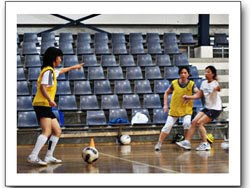 Guys who see the female quota (there is usually is a requirement to play a minimum of 2 girls in a mixed soccer 7-a-side team, for example) as just a rule that has to be complied with and once the game is on, omit or forget to play the game in true ‘mixed’ soccer spirit.


 Stride to the ball. The foot that will not be striking the ball - the supporting foot - is planted alongside the ball (15-20cm or a little less than the ball's width) with the toe pointing in the direction of the target. If your toe is pointing at the target, then your body and hips should be also be facing the target. The knee of this supporting foot should be bent slightly for balance, and your eyes should be on the ball. Hold your arms out away from your body also for balance.